Welcome to the complete guide to the Goreme Open Air Museum, a UNESCO World Heritage site housing some of the best preserved Byzantine cave churches and frescoes in Cappadocia.
Crucial Travel Tip: Do not discard your entrance ticket! The same ticket grants you access to the Buckle Church (Tokalı Kilise), located just outside the main museum exit down the hill.
Practical Visitor Info & Route Tips
- Physical Route: The museum pathway goes mostly uphill. If you have difficulty walking, follow the trail until you reach the Snake Church, then retrace your steps back down to the exit.
- Photography Rules: Photography and video are strictly prohibited inside the cave churches and chapels to preserve the ancient pigments. You may take photos outside, in refectories and in kitchen areas.
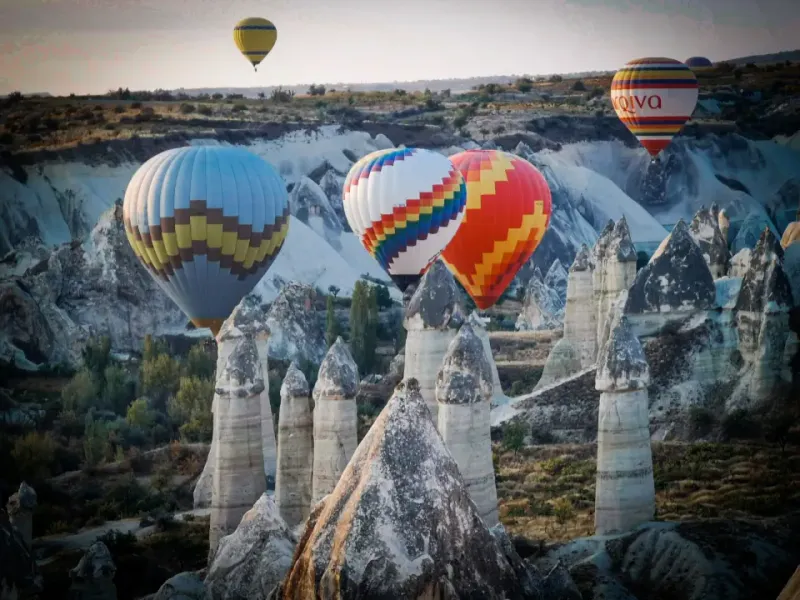
- Geology: Cappadocia’s rock is soft volcanic tuff (spelled t-u-f-f). It is soft enough to carve with hand chisels, allowing entire multi-story monasteries, chapels and dining halls to be sculpted directly into the cliffside.
1. The Entrance: Nunnery & St. Basil Chapel
As you pass the entrance turnstiles, you will see two multi-story rock formations resembling apartment complexes:
- Nun’s Convent & Monk’s Dormitory (carved after the 9th century).
Across the main clearing sits the Chapel of Saint Basil. Inside, you will observe rectangular floor tombs where key members of the monastic community were buried.
Red Ochre & Warrior Saints
The left wall features simple red ochre paintings, which are earthy pigments applied directly to raw stone without plaster, typical of 10th and 11th century Cappadocian art:
- Maltese Crosses and geometric patterns.
- Saint George & Saint Theodore: Two warrior saints on horseback fighting side by side.
- Saint George is always depicted riding a white horse.
- Saint Theodore is always depicted riding a brown horse.
2. The Legacy of Saint Basil
In the 4th century, Basil of Caesarea (Saint Basil) revolutionized Christian monasticism in Cappadocia. Instead of isolated hermits living in the wilderness, Basil organized monks into communal living centers where they shared meals, work and education.
Because the local population was largely illiterate, monks created visual sermons on cave walls to teach biblical history, ranging from simple red symbols to elaborate multi-layered frescoes.
3. The Apple Church (Elmalı Kilise)
Structurally sophisticated, the Apple Church features four carved columns supporting nine small domes in a cross in square layout.
- Fresco Technique: Wealthy donors funded a master artist who applied smooth wet plaster to the walls before adding pigments, bonding the artwork to the stone.
- Main Apse (Supplication / Deesis): Features Jesus on a throne flanked by the Virgin Mary and Saint John the Baptist pleading for humanity’s salvation.
- Central Dome: Depicts Christ Almighty (Pantokrator) surrounded by the Four Evangelists (Matthew, Mark, Luke and John).
- Key Scenes:
- Crucifixion: Features celestial symbols (white circle for the moon, red circle for the sun) representing the darkness during the crucifixion.
- Last Supper: Uniquely depicts Jesus sitting at the far left end of the table (the position of honor in early Byzantine tradition) rather than the center.
- Triumphal Entry: Jesus riding into Jerusalem on a donkey to represent a king of peace rather than a warrior.
4. Chapel of St. Barbara & The Snake Church
Chapel of Saint Barbara
Contains early, hand-drawn floral patterns and red crosses, alongside later professional portraits of Saint Barbara, Christ Almighty and warrior saints.
Snake Church (Yılanlı Kilise)
A long barrel vaulted cave named after a famous fresco:
- Slaying the Serpent: Saint George and Saint Theodore spear a giant serpent representing paganism or evil.
- Emperor Constantine & Saint Helena: Depicted holding the True Cross, commemorating Helena’s discovery of the crucifixion cross in Jerusalem.
- Saint Onuphrius: An early desert hermit depicted with a long white beard and a body covered only by foliage.
5. Monastic Refectories & Kitchens
Further up the trail, you will reach the communal dining halls (refectories). Here, long stone tables and benches were carved directly out of the living rock. Monks ate simple meals in silence while scriptures were read aloud from elevated niches.
6. The Dark Church (Karanlık Kilise)
(Note: Requires a small additional entry ticket, which is well worth it for historical preservation).
Because this church had only one small window to admit sunlight, its 12th century frescoes remain the most vibrant and undamaged in all of Cappadocia.
Highlights Inside the Dark Church:
- Ascension of Jesus: Located right near the small entryway.
- Young Jesus: A rare portrait of Jesus depicted as a child with a cross halo above the main apse.
- Nativity & Sator Square: Features the Star of Bethlehem, midwives bathing baby Jesus, and a shepherd named Sator, a nod to the ancient Roman Sator Square protective anagram.
- Harrowing of Hell (Anastasis): A magnificent scene of Christ stepping on a defeated Hades and pulling Adam and Eve out of Limbo.
- The Last Supper: The best preserved depiction in the region, featuring a fish on the table (an early Christian secret acrostic: ICHTHYS).
7. St. Catherine Chapel & The Sandal Church
Chapel of Saint Catherine
A burial chapel featuring three distinct cross styles carved above its entrance: Cross Pattée, Maltese Cross and Greek Cross.
Sandal Church (Çarıklı Kilise)
Named after two small indentations in the rock floor beneath the main apse that resemble footprints wearing sandals.
- The Donors: Features a portrait of a local Christian donor wearing a traditional turban and kaftan, showcasing the cultural overlap of late Byzantine Cappadocia.
8. Outside the Gates: The Buckle Church (Tokalı Kilise)
As you leave the main museum grounds, walk down toward the parking area and look for the steps on your right leading to the Buckle Church (Tokalı Kilise). Included with your main museum ticket, this cavernous church features breathtaking lapis lazuli blue frescoes depicting the life of Christ in monumental scale.