Episode Summary: A level by level walkthrough of Kaymakli Underground City in Cappadocia. Learn how thousands of civilians survived ancient invasions deep beneath the earth, explore subterranean cave churches, ancient wineries and stone rolling doors.
Introduction: Ancient Bunkers & Food Storage
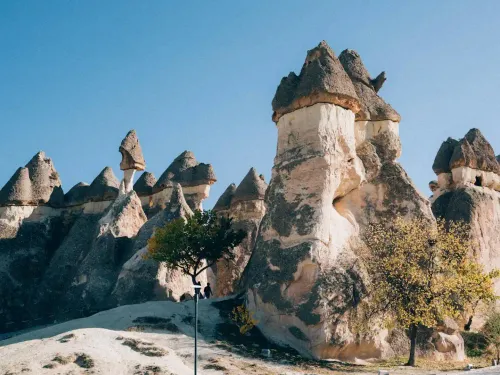
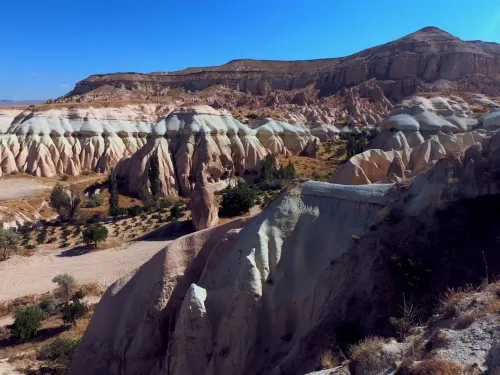
Thousands of years ago, people carved vast cave systems deep beneath the volcanic landscape of Cappadocia to confuse invading armies. While dozens of underground settlements have been discovered across the region, Kaymakli is the largest underground city open to visitors.
Although we call them “cities,” these complex cave networks were not permanent residences. During peaceful times, they functioned primarily as natural food storage facilities for local farmers. People moved into these deep subterranean networks to live only during active war and foreign invasions.
Level 1: Stables & Farm Animals
The first level at the entrance is the only way in and out of the entire complex.
This top level was reserved specifically for farm animals. Bringing livestock into the very first cave saved time during a surprise attack. Dragging horses, cows or goats further down narrow tunnels would have been time consuming.
- Feed Troughs: Notice the carved stone holes along the walls where animal feed was placed.
- Tether Holes: Small holes drilled into the stone allowed farmers to tie ropes so animals wouldn’t stray.
- Purpose: Keeping livestock on this level ensured a steady supply of dairy, meat and food during long sieges.
Level 2: The Cave Church & Natural Climate Control
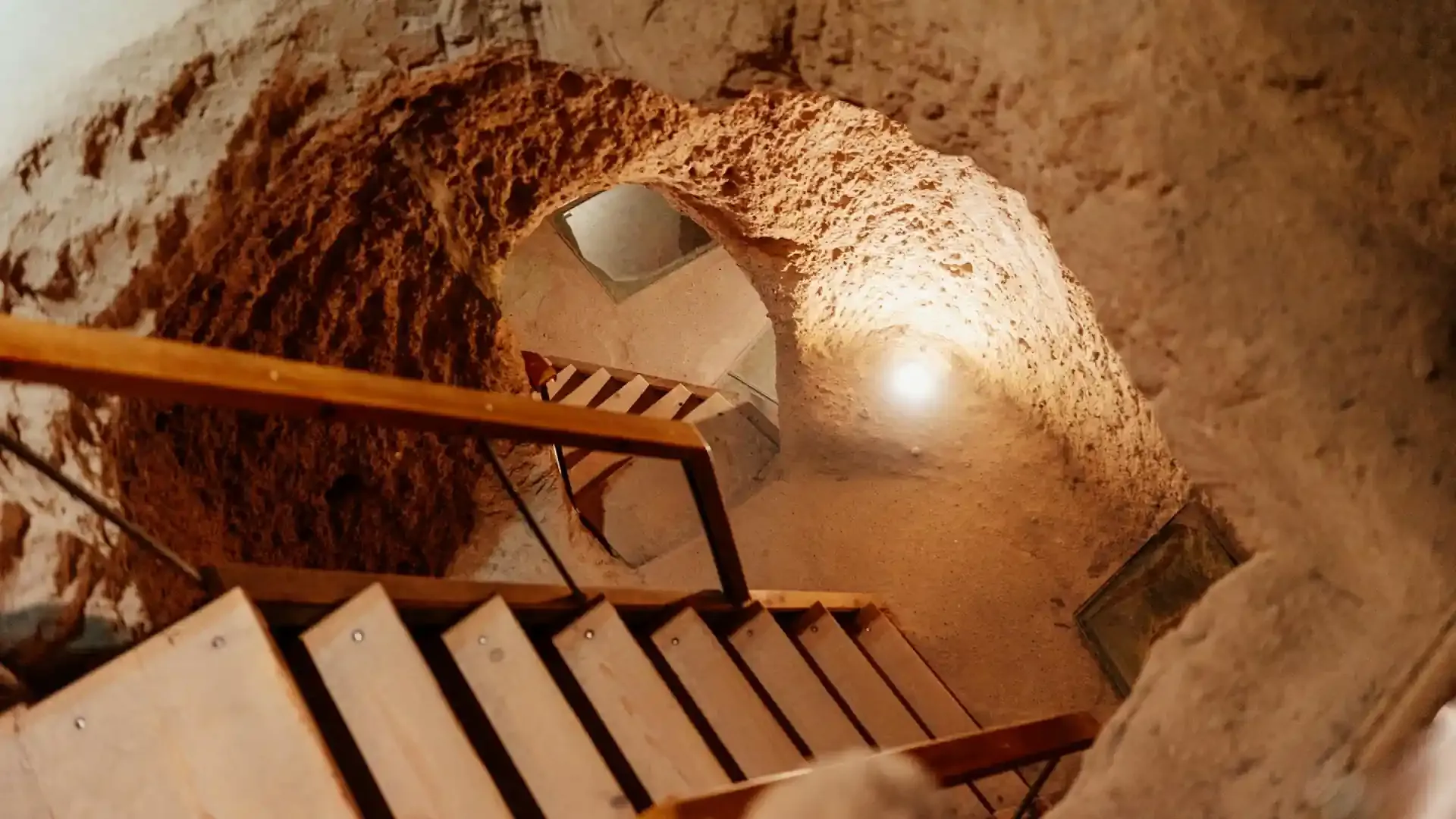
Following the red arrows through the first tunnel brings you to the second level.
⚠️ The Exit Decision Point: After visiting Level 2, you must decide whether to continue deeper or head for the exit. From this point forward, many tunnels become narrow and low, requiring you to crouch. While you don’t need to crawl on your hands and knees, it is not recommended for anyone with severe claustrophobia or respiratory issues. If you prefer to exit early, follow the blue arrows.
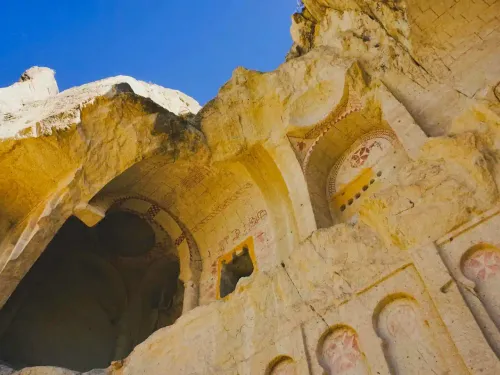
The Subterranean Church
Because this underground city served as an emergency bunker, its church is simple and utilitarian:
- No Wall Paintings: Unlike the surface churches of Cappadoica, there are no colorful frescoes here.
- Carved Reliefs: Simple relief crosses are carved directly into the stone walls.
- The Altar: A small altar sits in front of the main apse, featuring a faint relief of the Tree of Life.
- Tomb Chamber: A small window on the right reveals an adjacent room used for burials during times of siege.
Geothermal Insulation: Nature’s Refrigerator
To the left of the church altar, a tunnel leads to the main storage chambers. The surrounding volcanic tuff rock provides natural temperature regulation:
| Season |
Outside Temperature |
Inside Cave Temperature |
| Summer |
100°F (40°C) |
70°F (20°C) |
| Winter |
20°F to 30°F (-5°C to 0°C) |
60°F (15°C) |
This constant year round climate prevented crops, wine and food supplies from spoiling, making the caves the permanent pantry for the surface village above.
Level 3: The Winery & The Rolling Stone Door
Taking the small tunnel to the right of the main storage area brings you down to the third level.
The Winery
To your left is a traditional wine pressing pool. Workers would crush freshly harvested grapes by foot in the upper basin; the juice then flowed through a small drainage hole into a collection vessel below.
The Indiana Jones Rolling Stone Door
The highlight of Level 3 is a massive, circular stone rolling door resting behind two carved pillars:
- One Way Defense: Defenders inside the city could easily roll this heavy stone wheel into place to block the narrow tunnel entrance.
- No Outside Handles: For an invading enemy approaching from the tunnel, opening the door was virtually impossible. There were no handles and the tunnel was so tight that only one soldier could reach the door at a time.
- Combat Strategy: Defenders used the small hole carved through the center of the wheel to thrust spears or shoot arrows at trapped enemies.
- Forced Crouch Position: To fit through these tight tunnels, invading soldiers had to leave their large shields, heavy armor and long swords outside. Armed with only short daggers and forced to crouch, enemies were at a total tactical disadvantage.
The tunnel on the left side of the rolling door leads to the fourth and deepest level open to the public today.
Oil Lamp Cutouts & The Ventilation Shaft
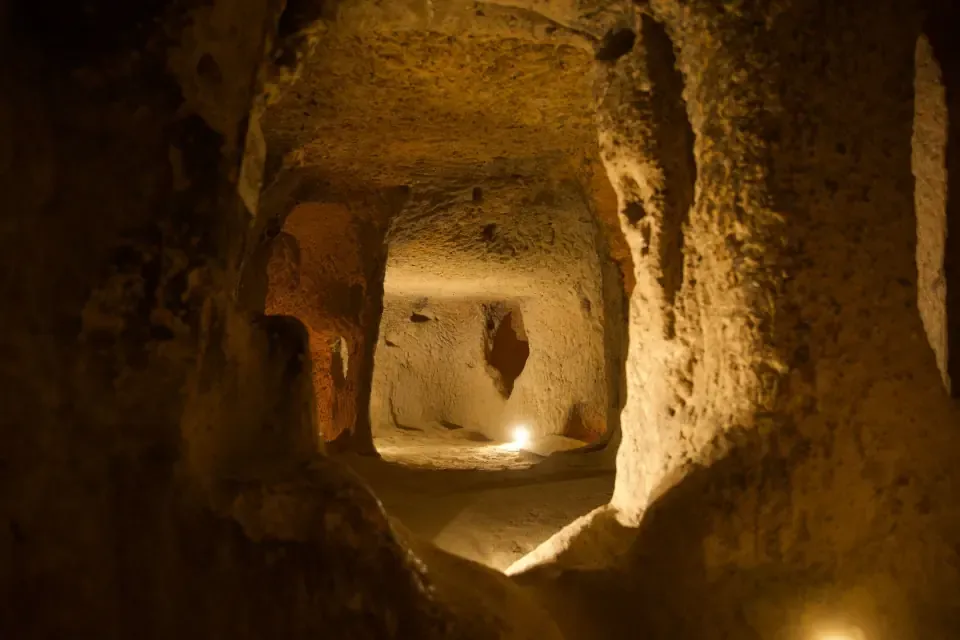
As you walk through the longest tunnel in the complex, look for palm sized cutouts carved into the walls. These held small clay lamps fueled by linseed oil, providing the main source of light underground.
Halfway down the tunnel, a side window opens into a massive 180 foot (60 meter) vertical ventilation shaft:
- Fresh Air & Water: Fresh air pulled from the surface still circulates through this shaft today. Deep at the bottom, the shaft tapped into an underground water table, serving as the city’s water well.
- Anti Poisoning Architecture: To prevent surface enemies from locating the well or poisoning the water, the shaft did not run in a straight vertical line to the top. It featured angled turns so anyone looking down from above would see only a shallow hole.
Subterranean Wine Cellars
In Level 4, you will see empty floor basins used for grape processing and small wall niches designed to hold wine jugs upright. Storing wine deep underground allowed it to ferment at ideal, stable temperatures year round.
The Soot Covered Kitchens
A tunnel leading upward opens into the kitchen area:
- Blackened Ceilings: The walls and ceilings here are covered in thick, pitch black soot. Cook fires were burned inside these caves; the porous volcanic tuff rock absorbed the smoke, leaving a permanent black stain that archaeologists use to identify kitchens.
- Basalt Grinding Stone: In the center of the kitchen sits a heavy, circular block of basalt rock covered in hand carved dimples, likely used for grinding spices, herbs and grains.
History & Practical Use of Kaymakli
- Ancient Origins: The earliest sections of the underground cities were carved by the Hittites more than 3,000 years ago.
- Successive Empires: Over centuries, every major civilization in Cappadocia, including the Persians, Greeks, Romans, Byzantines and Turks expanded and utilized these caves as places of refuge.
- Modern Rediscovery: Knowledge of the deep underground complexes faded over time. Kaymakli was rediscovered in 1957 and officially opened to the public in 1964.
- Cave Houses vs. Underground Cities: While surface cave houses were built for individual private families, underground cities were built as communal shelters capable of housing over 6,000 refugees (mostly women, children and the elderly) for months at a time.
- Depth: Kaymakli originally contained 8 levels, but lower floors collapsed over time; today, only the top 4 levels are accessible.
Support the Show: If you found this audio guide helpful during your visit, please leave a rating or review on Spotify, Apple Podcasts or YouTube.